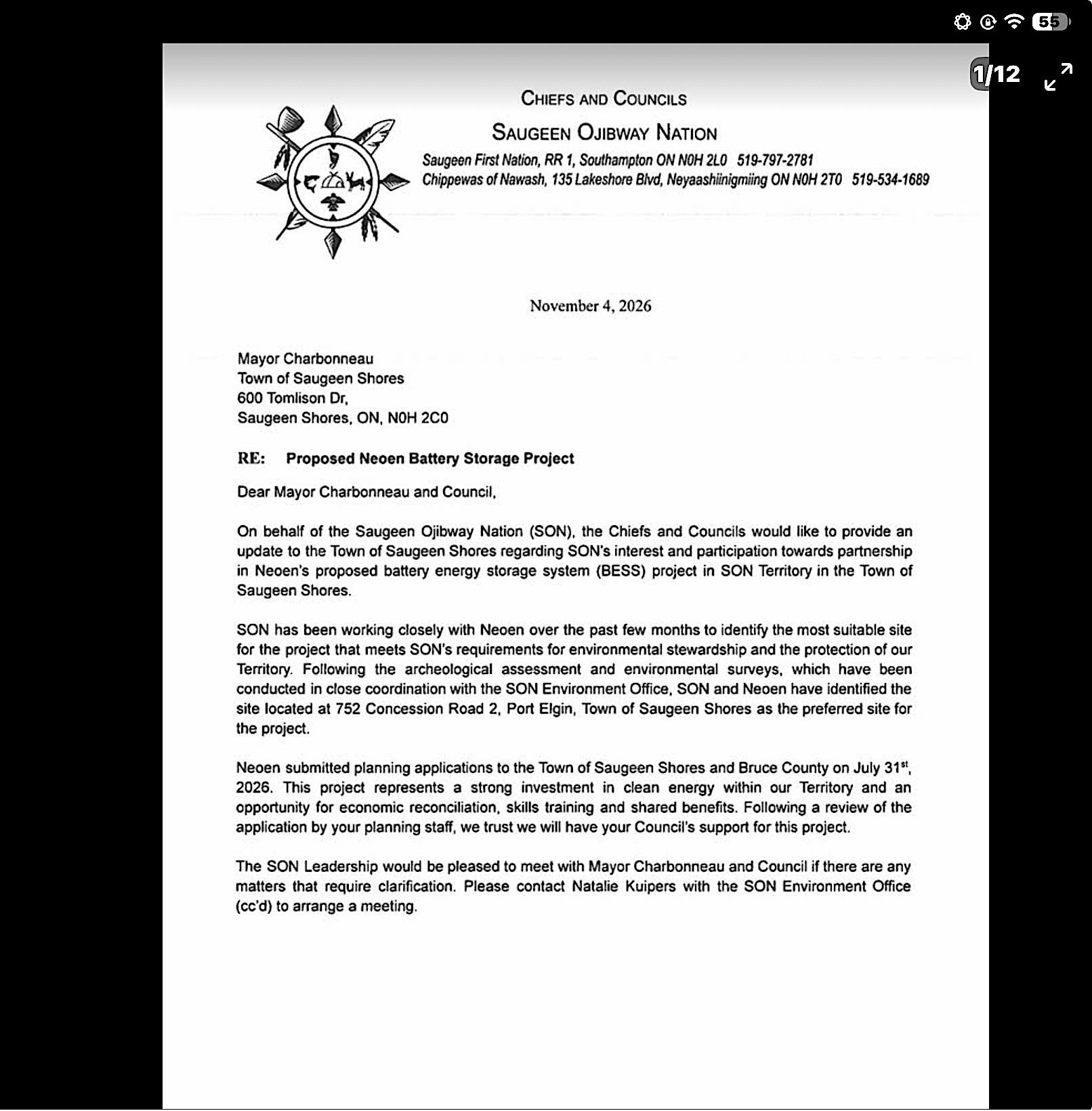

The proposal to build a mega-battery energy storage facility only three kilometres from the community of Port Elgin (Saugeen Shores) has raised the concerns of many who are adjacent neighbours to the site chosen.

According to neighbours who have owned and farmed the surrounding lands for several generations, the loss of farmland is critical.
According to statistics, Ontario loses approximately 319 acres of farmland to development every day. The loss can be to housing development, highways, industrial facilities, and energy projects such as the one proposed by Neoen. While the loss of farmland is crucial, it also has a far sweeping affect on the loss of wildlife habitat, biodiversity, groundwater and migratory pathways for birds, bats and Monarch butterflies (an endangered species). Agriculture is not only about farmland, it is about the lifeblood of rural communities.
The company proposing the battery-storage facility, Neoen of France, is the applicant for the 20-year 400 MgWatt facility on farmland which, according to Ontario’s Agricultural Mapping, is designated Class 1 agricultural land – the province’s highest-quality farmland.
According to a neighbour whose family farmed the proposed site where they grew oats, barley, soybeans, corn and other cash crops, “According to the company and the owner who would be leasing the site to Neoen, it is marginal farmland. If that’s true, why did the owner buy the land for a reported $2.3milion in the first place, if not because this was the plan from the beginning?”
There are some 480 cash crop farms that focus on grains and field crops across the county’s interior breadbasket. In addition, an adjacent neighbouring farm to the proposed site recently captured third place for their quality of Canola crop in all of Ontario, demonstrating the value of farmland in Bruce County.
The National Farmers Union states that, under a new ‘Canada’s National Food Security Strategy’, “…protecting the land capable of producing food should be one of the foundations of Food security. It’s about more than increasing production, it begins by ensuring that future generations still have productive farmland to farm.”
Closer to home in Bruce County where the proposed battery storage facility would be located immediately south of Port Elgin, the County’s Official Plan recognizes that agriculture is one of the three pillars of the economy, that include tourism and energy.
In a Bruce County report, it says that “… natural assets are finite, non-renewable resources and our agricultural lands are the foundation for food, fiber, the local food economy, agri-food exports and economic prosperity.”
In the County Official Plan, it also refers to Indigenous neighbours as community members, … there are linkages between land use planning, and Indigenous economies and cultures, their use of traditional lands, and commitment to a healthy environment. Engagement with Indigenous communities on land use planning issues helps with relationship building, information sharing, and achieving common goals related to social and economic development.”
Over the years, Saugeen Shores and Saugeen First Nation have been working together to create a collaboration focusing on friendship, tourism and economic development and they recently signed a Friendship accord and Economic agreement.
In a recent public letter however, from Saugeen Ojibway Nation (SON) to Saugeen Shores Town Council, SON stated that it approves of the selected battery storage facility. The letter also states that SON has been working with Neoen for the “past few months” however, at a public meeting held in August (2026), SON (Nawash) stated they had been in negotiations “… for a couple of years” and have a 50% equity in the project.
According to Neoen at the public meeting, they stated that, “The IESO (Independent Electricity System Operator) dictates and the Ministry of Energy want us here.”
Prior to the site selection near Port Elgin, the company was turned down for a site by Arran-Elderslie Council, a neighbouring municipality of Saugeen Shores.
The National Farmers Union also went on to say however that, “Ontario does not need to choose between energy security and and food security. We can achieve both with careful planning. However, once prime farmland is paved over and the ecological systems that surround it are disrupted, there is no practical way to bring them back. Protecting best farmland is not about resisting change, it is about ensuring that the land, water and ecosystems that sustain agriculture remain intact for the farmers who will feed people tomorrow.”
First Nations people also believe in the protection of land, water and the environment and through their Grandfather Seven teachings, ensuring that future generations live on a sustainable land in a sustainable environment.
At the August public meeting, SON said that, “Our responsibility is to ensure development is carried out responsibly and in alignment with our obligation to the seven generations … Neoen has respected our environmental standards including protection measures that rise above and beyond Provincial and Federal requirements … everything for SON, including an archeological assessment, has been done and approved by our SON office and recommended to our Council. Neoen has demonstrated willingness to meet SON’s high standards and to bring jobs to the community.”
While during the proposed construction phase there would be jobs created, at the completion and during operation of the proposed facility, there would be very few jobs and operations would, in fact, be handled remotely from California, according to Neoen, where the batteries are produced by Tesla.
Concerns remain regarding the proposed site selection on what is considered part of the prime agricultural farmland in Bruce County and a petition has been launched at change.org.