
In recent years, Canada’s medical isotope industry has experienced a period of remarkable growth and innovation. Throughout this period, Canada has significantly expanded its nuclear isotope production capacity, increased patient access to life-changing radiopharmaceuticals, invested in healthcare innovation and research, and received strong support from all levels of government, creating new opportunities to strengthen Canada’s leadership in this critical sector.
Radiopharmaceuticals, which combine the power of a nuclear isotope with a revolutionary drug or device, are changing the way that physicians are diagnosing and treating patients with illnesses like cancer. With decades of experience in the production, research, and use of these radiopharmaceuticals, Canada has emerged as an international leader in this field, paving the way in the global fight against cancer using medical isotopes. By continuing to leverage our world-class nuclear sector, research institutions, healthcare expertise, and decades of leadership in isotope production and innovation, Canada can not only seize this growing opportunity of economic prosperity but continue to offer hope to patients around the world for decades to come.
Helping to bring together the isotope ecosystem under this goal, the Canadian Nuclear Isotope Council (CNIC) continues to drive its Isotopes for Hope campaign. The campaign, originally launched in March 2023, entered its third phase in November of 2025, affirming its ambitious goal of doubling Canada’s production of medical isotopes by 2030.
In support of this goal, communities across the country are stepping up to the challenge to bring this vision into reality. New regional initiatives and innovation hubs have emerged to strengthen Canada’s isotope supply, attract international investment, support new research and clinical innovation, and build stronger connections across the entire isotope ecosystem, recognizing that each community has its unique capabilities and a role to play. Among the earliest of these regional efforts was the creation of the Southwestern Ontario Isotope Coalition (SOIC) in June 2023. The SOIC was established by the City of Owen Sound and the Nuclear Innovation Institute, with support from the CNIC, to build on Southwestern Ontario’s unique isotope strengths, raise awareness of region’s critical role in Canada’s isotope sector, and foster collaboration across the isotope value chain.
Today, the ongoing partnership between the CNIC and SOIC demonstrates how working together through regional collaboration can help expand Canada’s role in the global supply of medical isotopes, create more economic opportunities and jobs in Canada, raise awareness to the crucial role isotopes play within our community healthcare systems, and ensure local patients continue to benefit from innovative medical isotopes produced close to home,
Most recently, the impact of this regional collaboration was reflected at the CNIC‘s Annual Awards Reception held in April at the National Arts Centre in Ottawa. More than 150 industry leaders, elected officials, healthcare leaders, stakeholders, and CNIC members gathered to celebrate the achievements driving the success of Canada’s isotope ecosystem. The event featured the Honourable Tim Hodgson, Canada’s Minister of Energy and Natural Resources, the Honourable Lisa Thompson, Ontario’s Minister of Rural Affairs, and the Honourable Victor Fedeli, Ontario’s Minister of Economic Development, Job Creation and Trade, who shared remarks recognizing the sector’s growing importance to both healthcare and economic development.
This year, the CNIC presented nine awards to recognize individuals and organizations that have shown incredible leadership and championed advocacy in the Canadian isotope sector. One of these awards, the Indigenous Partnership Award, recognizes a significant milestone or initiative related to Indigenous communities.
This year’s Indigenous Partnership Award shone a spotlight on a significant milestone in Southwestern Ontario, celebrating a historic moment for economic reconciliation in the isotope community. The Award was presented to TD Securities Inc., Pape Salter Teillet LLP, and McCarthy Tétrault LLP for their legal and financial contributions to enable the groundbreaking $250 million expansion to the Gamzook’aamin aakoziwin partnership in December 2025. This expanded partnership will deliver cancer-fighting Canadian-made isotopes while creating lasting economic benefits for the Saugeen Ojibway Nation.
Beyond investing in key partnerships between Indigenous communities and the isotope sector, the region is also helping build the talent pipeline needed to sustain Canada’s isotope leadership for decades to come. This commitment to collaboration and talent development was evident at the Canadian Radiotheranostics Leaders’ Summit 2026 in May in Toronto.
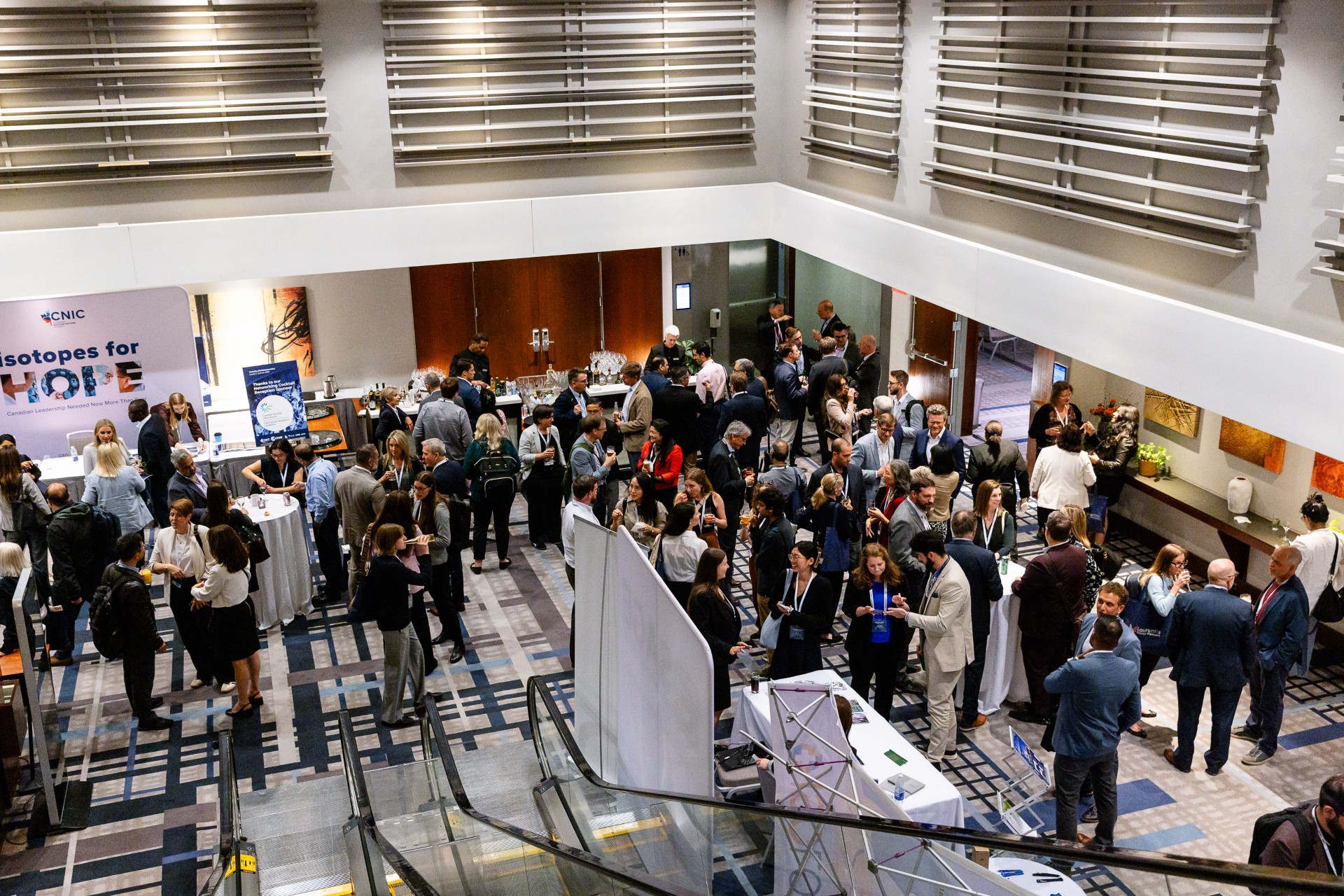
Held annually by the CNIC, the Canadian Medical Isotope Ecosystem (CMIE), and a consortium of leading academic institutions including University Health Network, London Health Sciences Centre, BC Cancer, and the Centre for Addiction and Mental Health, the Leaders’ Summit 2026 brought together more than 500 leaders from across the global isotope supply chain, business and investment communities, government representatives, healthcare leaders, academics, students and more to shape Canada’s isotope leadership to support patients globally. The theme of this year’s Leaders’ Summit was Collaboration in Action: Unleashing Canada’s Radioisotope Future, which provided a platform to address sector challenges and identify opportunities to improve patient access, increase production, and strengthen Canada’s supply chain.
Most notably, this year’s Leaders’ Summit experienced remarkable growth of its Student Program, which provides funding to enable promising post-secondary students from across Canada to participate in the Summit. The program, sponsored by Nordion and supported by the SOIC, welcomed the largest cohort of students to date, providing them with access to leading experts, researchers, and organizations operating throughout the isotope sector to learn more about the industry and potential career opportunities in the sector. The SOIC has been a part of the Leaders’ Summit Student Program since its first year, enabling continued expansion to include more students from more institutions and demonstrating the region’s ongoing commitment to developing the next generation of isotope leaders.

“Across southwestern Ontario, we’re seeing firsthand how powerful regional collaboration can be,” said Jessica Linthorne, President and CEO, Nuclear Innovation Institute—host of the Southwestern Ontario Isotope Coalition. “With dozens of Regional Collaboration Members—from local governments to health care to industry partners—we’re building the connections that turn isotope innovation into real economic and health benefits for Canadians. As we support the isotope ecosystem right here in our region, this momentum is helping position Canada as a global leader in isotopes.”
Together, these recent achievements and milestones are key examples of how ongoing regional collaboration and support can generate national impact. From advancing Indigenous partnerships and supporting major economic development opportunities, to leading collaborative programs that support future talent and workforce development, regional communities are helping to shape Canada’s isotope future.
“Canada’s strength and leadership in isotope innovation comes from collaboration and partnerships” said Melody Greaves, Executive Director of the CNIC and VP of Government Relations. “The work between the CNIC and initiatives like the SOIC demonstrate what is possible when we work together to bring our goals to reality.”
As the demand for medical isotopes continues to grow around the world, and the global isotope market is now estimated to reach US $42 billion by 2033, Canada’s success and leadership will depend on maintaining this spirit of collaboration. By building on regional strengths and working together with a Team Canada approach across the entire isotope supply chain, Canada is well positioned to remain a global leader in isotope innovation and ensure patients across the world have access to the life-saving isotopes for generations to come.
The Canadian Nuclear Isotope Council (CNIC) is an independent, not-for-profit advocacy and member services organization. The CNIC supports over 100 members from across science, academia, healthcare, and nuclear-sector organizations dedicated to maintaining Canada’s position as a global leader in the production of life-saving isotopes. The CNIC raises awareness and advocates for long-term policies that support health-care innovation and will save countless lives for decades to come. To learn more about the CNIC, visit www.CanadianIsotopes.ca and follow us on Facebook, Twitter, and LinkedIn.