
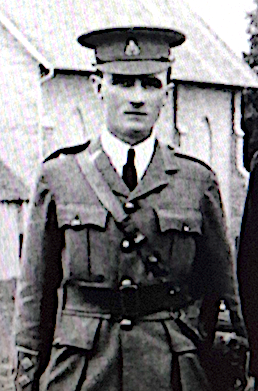
 On June 15, 1915, a young 28-year-old Capt. Joseph Lionel Tranter of Southampton was killed in France.
Born in Saugeen Township in 1887 on the family farm on the 14 Concession close to Southampton, he joined the local militia in 1905 and, when World War I was declared in 1914, he travelled to Val Cartier in Quebec to enlist and then was shipped out to England as part of the 1st Battalion Canadian Infantry arriving in England on October 14th.
Following training, they left for France in February, 1915 and, in June, fighting raged near Vimy Ridge. The battle began badly for the Canadians and they had to retreat and in the morning the 1st Battalion had almost 400 casualties. One of those was Joseph Lionel Tranter, who was buried 599 feet behind the trench he fought in.
Today, however, thanks to Acadia University in Nova Scotia, the Canadian Remembrance and Recovery Project (CRRP) and local historian G. William (Bill) Streeter, Capt. Tranter and others may be recovered, as a University team heads to France.
“I read an article in the Globe and Mail about Dr. Aaron and the Recovery project and just had to become involved, given our local connection with Capt. Tranter,” said Streeter. “I knew when and where he died and, although his name is on the Vimy Memorial, he and others have no proper grave-sites in a military cemetery and that should be corrected.”
An interdisciplinary team of experts leads the project that will also include a student crew. Dr. Aaron Taylor, an established archeologist with extensive experience recovering fallen soldiers in Austria, France, and Belgium and Adjunct Professor at Acadia University heads up the project along with Dr. Kim Bergeron and June MacDonald-Jenkins.
Bergeron, a multidisciplinary researcher, with “… expertise in leading social innovation and applied research projects to identify evidence-formed practices and policies to influence structural and systemic barriers”, is also an Assistant Professor, Continuing Adjunct at Queen’s University in Kingston, Ontario.
MacDonald-Jenkins is an experienced social science researcher and consultant. She has partnered with specialists in “Investigative Genetic Genealogy (IGG), contributing to efforts aimed at resolving cold cases involving missing persons and unidentified human remains”.
According to the Acadia University website, the CRRP is a national initiative focused on the recovery, identification, and commemoration of Canada’s missing-in-action military service personnel (MIA-MSP) from World Wars I and II, and the Korean War. There are 27,000 MIA-MSP.
The project began in 2023 and, although initially launched in 2024 as the Acadia University Recovery Project, it was renamed the CRRP in 2025, with the support of Acadia’s Dean of Arts Office, to reflect the national scope of the proposed project.
To learn more about the overall focus and principles of the project, CLICK HERE.
The project is also fundraising and donations are welcome to help defray costs.
DONATE
Streeter, who has amassed a wealth of Canadian military research, will also soon be off to England and France to visit memorials, cemeteries, battle sites, etc. from WWII with a guide from “In the Footsteps Battlefield Tours“.