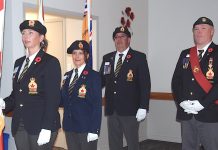

To the Editor:
This spring, I will travel to the Netherlands and the United Kingdom to participate in international commemorations marking the 80th anniversary of Victory in Europe (VE) Day.
My journey begins in the Netherlands, where I will attend four major commemorative events, including the Wageningen45 program with the Royal Canadian Legion. Wageningen—where the German surrender was signed in 1945—expects over 95,000 participants this year. I will be joining Canadians and Dutch citizens in ceremonies that honour the enduring bonds of friendship forged in the crucible of war.
Following these events, I will travel to London, where I have been invited to attend a service at Westminster Abbey, honouring all who served under the Commonwealth banner during the Second World War.
It is a profound honour to participate in these historic commemorations, representing Canada, the Royal Canadian Legion, and our legacy of service. I do so as a proud Canadian, the son of two WWII veterans, and a lifelong advocate for remembrance. This journey is personally funded as a small contribution toward preserving and honouring our shared military heritage.
Over the years, I’ve travelled to many sites of Canadian and Commonwealth sacrifice—Vimy Ridge, Passchendaele, Yokohama, and numerous Commonwealth War Graves—where I have participated in remembrance ceremonies and taken time to reflect on the lives lost and the values upheld by our servicemen and women.
It is especially meaningful to share this message today, April 9th—Vimy Ridge Day—a national day of remembrance for one of Canada’s most defining moments in the First World War. The victory at Vimy Ridge, achieved at great cost, is remembered not only as a military triumph but as the birth of a nation—a moment when soldiers from across Canada fought together for the first time as a unified force. That unity, forged in adversity, helped shape Canada’s identity on the world stage. It reminds us of the vital importance of remembering and honouring the service and sacrifice of those who came before us.
In the Netherlands, Canada’s role in liberation is not only remembered—it is venerated. The connection between Dutch communities and Canada runs deep and remains alive in both formal events and daily life. Every year, Dutch families, schoolchildren, veterans’ groups, and local governments gather to pay tribute. Cenotaphs are not idle monuments but living parts of community identity—surrounded by flowers, flags, and handwritten notes. These are not places visited only once a year, but centres of reflection and civic pride.
Many cenotaphs in the Netherlands go beyond stone and inscription; they incorporate sculpture, murals, and landscaped gardens, becoming expressions of public art and shared memory. Often designed by local artists or architects, they serve as daily reminders of the cost of freedom and the value of peace. They are intentionally placed in central squares, schoolyards, or near town halls—not tucked away—so that remembrance is woven into everyday life. Through this, communities pass on their history not only through ceremonies but through the physical and artistic fabric of their towns and villages.
It is difficult to overstate how important these commemorations are in Dutch society. They are not token gestures, but expressions of genuine, generational gratitude. Children are taught from a young age about the Canadian soldiers who helped bring freedom to their country. For many Dutch people, Canada is not just a far-off nation—it is a liberator, a friend, and a symbol of peace.
To understand the depth of this connection, I encourage you to explore the many emotional CBC documentaries available on YouTube about the liberation of the Netherlands—produced by The National, W5, and others. These programs convey powerful firsthand accounts from both veterans and civilians. With very few veterans still able to travel—now over 100 years old—this may be among the last major anniversaries with living witnesses present. Their legacy must be preserved.
Importantly, this deep and enduring respect for Canada is not limited to the Netherlands. In France, Belgium, Italy, Japan, and the UK, our veterans are warmly recognized, and Canada’s wartime contributions are commemorated with sincerity and gratitude. These international ties, rooted in shared sacrifice and peacekeeping, remain as vital today as ever.
To help further those bonds, I also hope to continue discussions and explore a possible sister-city relationship between Saugeen Shores and Zonnebeke (Passchendaele), Belgium—a community with a deep connection to Canadian sacrifice in the First World War. This initiative would strengthen cultural exchange and historical awareness between our communities.
I look forward to sharing my experiences upon my return.
With respect and appreciation,
John Willetts
Southampton