

DONALD ALBERT GILLIES
A BOY SOLDIER FROM SOUTHAMPTON
To legally enlist in the Canadian Expeditionary Force in WWI, all young men had to be at least 18 years of age at the time of enlistment. Stories are widespread of those who went in younger by not telling the truth about their actual age. There were also many recruitment officers that were being rewarded based on the number of recruits that they signed up and accepted.
This is the story of our own Southampton “Boy Soldier”. His story has some intrigue, mystery, lots of facts and some good memories. His name was DONALD ALBERT GILLIES.
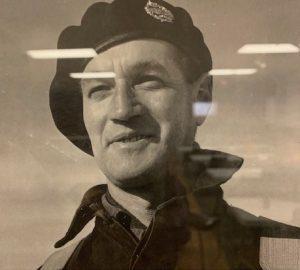 Donald was born on September 29, 1899, in a very remote place on the shores of James Bay that was known as Fort George in what then was the Regional District of Ungava. This area did not become part of Quebec until 1920. It was a Hudson Bay Trading Post, about 350 km North of Moose Factory on the east side of the bay. It had been a Cree settlement there for centuries. The people in this area were relocated in 1980, to make way for the James Bay Hydro Electric Project.
When Donald Albert Gillies was born in Fort George, we know that his mother Margaret, and his father Donald had both been born here in Bruce County. What had taken them to Fort George and for how long they remained there can only be speculation. We do know though, that there were whaling stations in Fort George, at that time, and we know that the trading post had attracted Inuit from the North. Both the Anglican and Catholic missionaries had churches and schools there and that the two churches had been rivals competing for the favour of the local people.
Sometime in the years that followed his birth, the family arrived in Southampton, and this is where the story of our “Boy Soldier” begins.
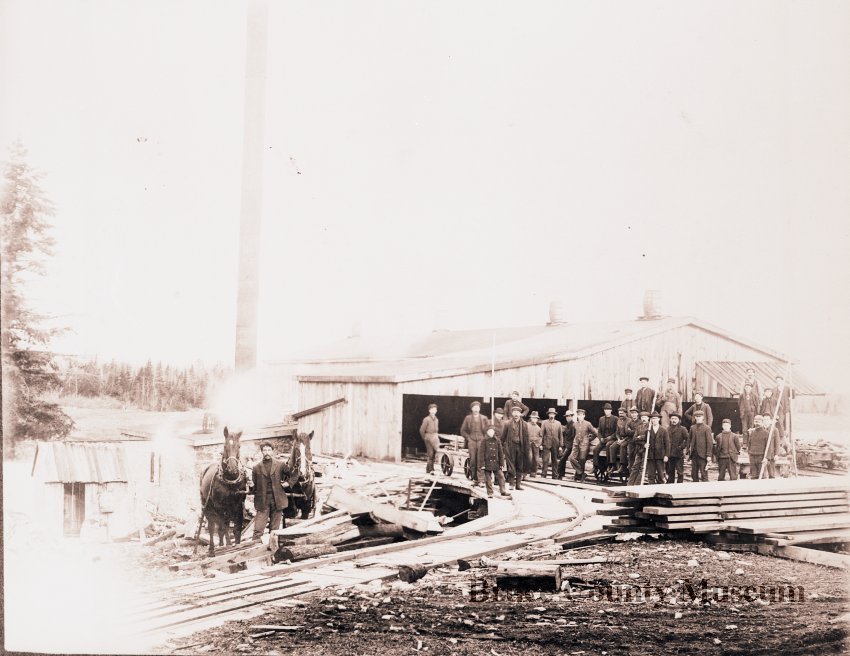
The Gillies family had lived throughout Bruce County from the late 1800’s. The Gillies name was synonymous in the wood producing, sawmill industry, and they were already prominent as workers and operators of sawmills in Southampton and Tobermory leading up to 1914 and the start of WWI.
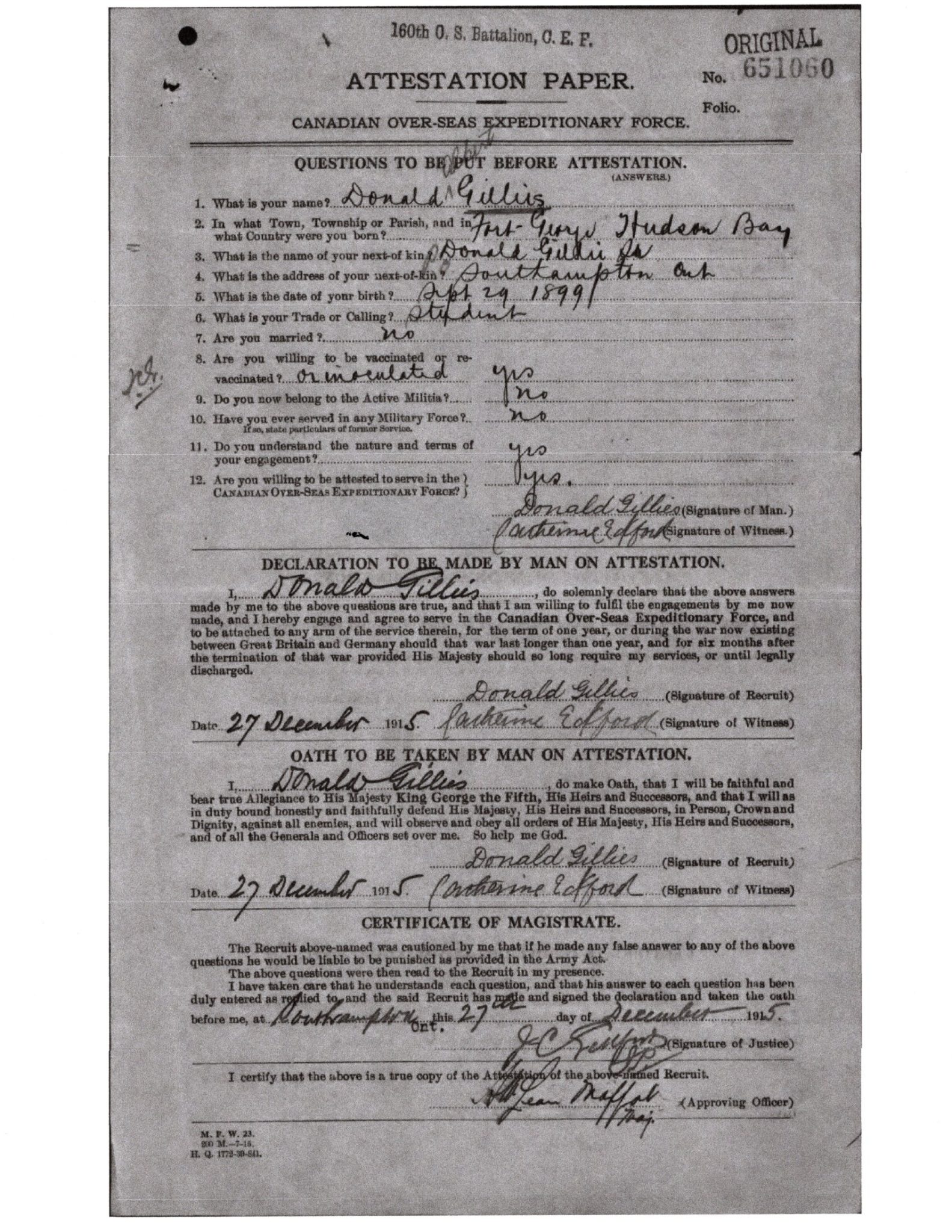
In December 1915, the establishment of the 160th Bruce Battalion led to a major enlistment of young men from every town and village in the county. Amongst the close to 1,200 that were recruited was a young Donald Albert Gillies. On December 27, 1915 when he enlisted, he was two days short of being 16 years and 3 months old. When we read Page 1 of his Attestment Application, we see that he completed his birth date accurately as September 29, 1899, and that the date of the document was December 29, 1915. Despite not being of the legal age of 18 for enlistment, his attestation papers were accepted based on the Witness Signature of one Catherine Eckford. This in itself is suspicious. If we look at the signature of the Recruitment Officer, we see that his name was J. C. Eckford. Mr. Eckford was a Justice of the Peace and the retired Southampton Town Clerk. Was this an opportunity for a recruitment officer to get another recruit and a financial award for his work?
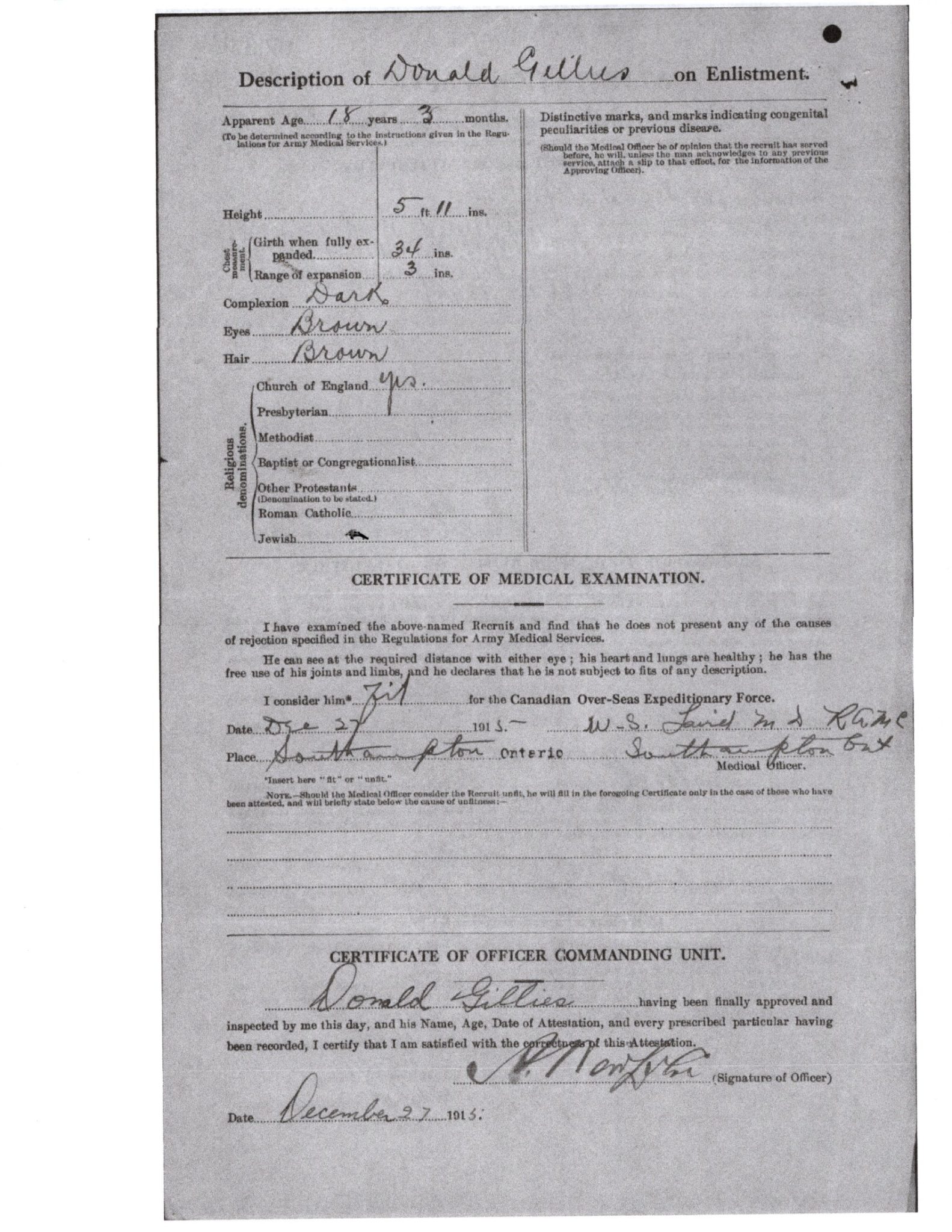
When we read the second page of the form that includes the Certificate of Medical Examination, we see at the top there is a heading “Apparent Age” and here is written “18 years and 3 Months”. It is signed by Dr. Laird, who was residing and practicing medicine at his home at 135 High Street. Did he ever see page 1??? One can only speculate what the word “apparent age” meant. Donald’s 5’ 11’ frame gave him an “apparent” age of 18 and 3 months
Along with about 45 others from Southampton, Donald began his military training. In early May of 1916, the recruits from across the county gathered in Walkerton to continue their training. Then in early June, the close to 1,200 men of the 160th marched to Chesley from Walkerton to receive their Regimental Battle Banners from the Ontario Premier William Hearst. They returned to Walkerton and left for London Ontario on June 12. Intensive training continued there until October when the final group with a total of 1,171, boarded a train for Halifax and found themselves in England by late October 1916.
The original plan had been to recruit from across Canada, a full division of 100,000 men. The government came close to reaching this goal, but organizing them into a division did not materialize, and the new recruits trained and waited through all of 1917. it was not until February of 1918 before the decision was made. There would not be a 5th Division and all of the latest recruits, including the men of the 160th, would become reserves and be sent to join other active battalions at the front as replacements for killed or injured soldiers. These fresh new recruits would add real strength to the Canadian Army and they did eventually help to lead to the end of hostilities later in 1918.
For the now 18-year-old Donald, he would transfer to the 1st Battalion Western Ontario Regiment. He arrived in France and joined his new group on March 28, 1918. They had been at the war’s front since early 1915.
Much of the time in France was spent preparing for the planned major event referred to as the 100 Days Offensive. Young Donald was right there in the action. The Offensive began on August 8, 1918 near the city of Amiens in France. Quoting the Canadian Government Historical website; “Following Amiens, the Canadian Corps became part of the British First Army and took on all of the most difficult and substantial offensive tasks of the army, for the rest of the war”. Death and injury were commonplace for all of the Canadian soldiers from then until the war ended that November.
Donald Gilles was near, what is known as the Scarpe, close to the city of Arras when, on September 1st he was shot in the left side of his chest. The bullet did not lodge in his chest but passed directly through. He was taken to the #14 Ambulatory Care Hospital in Fresnicourt. His treatment and recovery took almost 4 weeks. On September 27 he left hospital to return to his Corps. The offensive had moved on to the Battle of Canal-du-Nord where the fierce fighting continued. Finally, on November 11 the armistice was signed, and the fighting stopped.
For Donald, he remained on the French border with Germany until March 25, 1919 as part of the occupying force. On April 14, he sailed for home, ironically from Southampton England, on board the S. S. Olympic. There were two periods in its life when the Olympic was the largest passenger ship in the world. For a period before the Titantic, and for a period after the Titanic sank, the Olympic was the largest.
Donald was discharged in London, Ontario on April 24, 1919, now still a young 19 years and 5 months old but a lot more of a man.
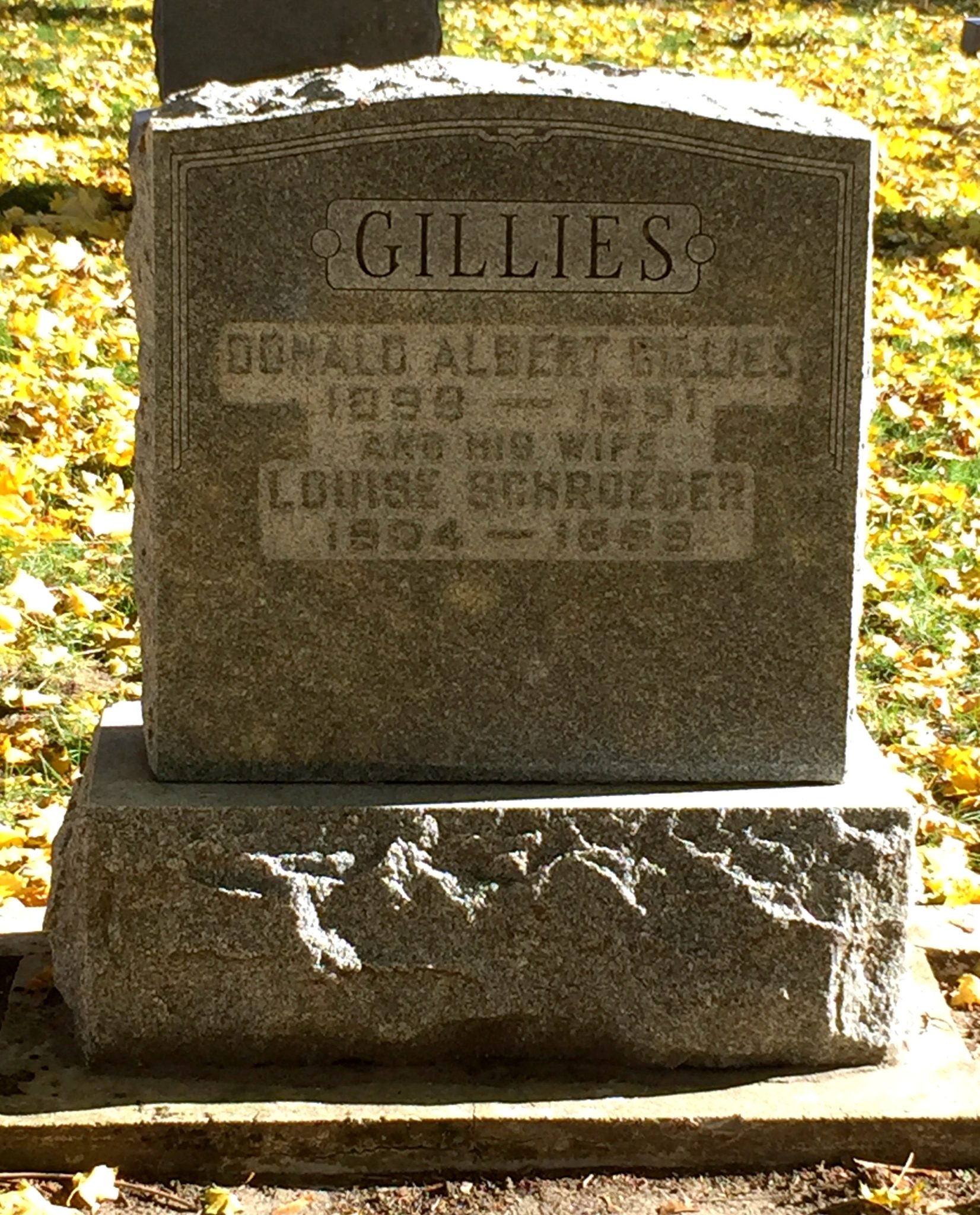
On August 17, 1923, he married Louise Schroeder who was living in Southampton with her parents, who had moved here from Grey County. They lived on Grey Street just south of High, and a son named John Robert was born in 1926.
When WWII began, Donald again enlisted and served. Military records for WWII survivors remain private today and are only available to direct descendants.
BUT we do know that Donald served two terms as President of our local Legion before WWII and one term after.
Donald died in 1951 at age 52.
Many in our town remember his wife Louise, as one of the many, very nice ladies that have worked in our Post office over the years. She was with the post office in 1953, when the Post office moved to its current location from, what for years was Thorncrest Outfitters and today is the coffee shop with the Red Door. Her son John joined the Canadian Army in the late 1950’s. We lived above the post office, and my father and Louise were work associates. Dad was a “real” baseball fan and he always did the World Series complete line score sheets. When the World Series ended these sheets would be packaged and forwarded to Louise’s son John Gillies who was stationed with the Canadian Army in Cyprus in the mid-1960s as a member of the Peace Keeping Force.
Louise passed away in 1968. Donald and Louise are buried in the Southampton cemetery.
WE SHALL REMEMBER THEM
Researched and
written by: G. William Streeter