
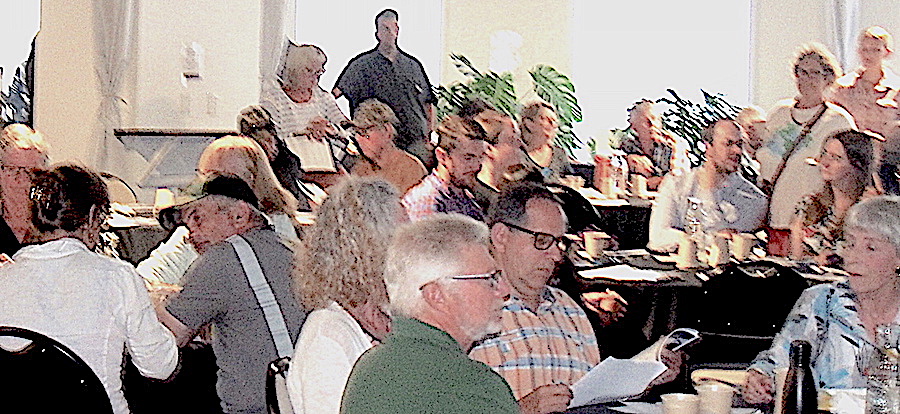
More than 200 people attended an information session, at the Powerlink building in Port Elgin, on the proposed Neoen battery storage facility to be located south of Port Elgin (Saugeen Shores).
Neoen was one of the 13 projects that was awarded a 20-year contract through the Independent Electricity System Operator (IESO) and in collaboration with Saugeen Ojibway Nation (SON), who are stakeholders, resulting in the 29-acre site selection on farmland south of Port Elgin. The site was selected primarily for its access to the transmission grid that will allow the 400MW bi-directional charge and discharge resource and because it could not be within 13km of Bruce Nuclear Power site.
Recently, the project was proposed for lands at Tara in Arran-Eldersle, however their Town Council voted against citing environmental concerns.
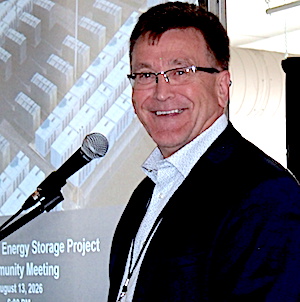
At the meeting, moderator by Bill Walker opened by explaining the role that the Independent Electricity System Operator (IESO) plays when it comes to electricity. “IESO is a on-profit Crown corporation and plays a significant role. It looks forward at the projected demand, the capability that we have, what is needed to fill gaps and factors in everything. Then, typically they will come forward to the government with a process of recommendations of what will be needed in the future. The IESO operates Ontario’s power grid and projects that Ontario’s demand will increase by more than 60% by 2050. The Ministry of Energy and Mines sets the long-term energy strategy and establishes a competitive procurement framework for new energy sources. In 2024, it launched its long-term procurement strategy and awarded thirteen 20-year contracts totalling 2.194.91 megawatts of new capacity. The Ministry of Environment, Conservation and Parks and local governments assess applications to ensure applications meet required standards.”
The technology, known as BESS ( Battery Energy Storage Systems), stores electricity in batteries and later discharges to an electrical grid. Battery storage can be used in commercial and domestic settings. For safety and security, the actual batteries are housed in their own structures, like warehouses or containers. Neoen was a pioneer in the field of battery storage, founded in 2008 and has been in Canada since 2022, and is now in three provinces – Alberta, Saskatchewan and Ontario.
Several Neoen staff and two consultants then gave presentations about the proposed development, following which they took questions from the audience.
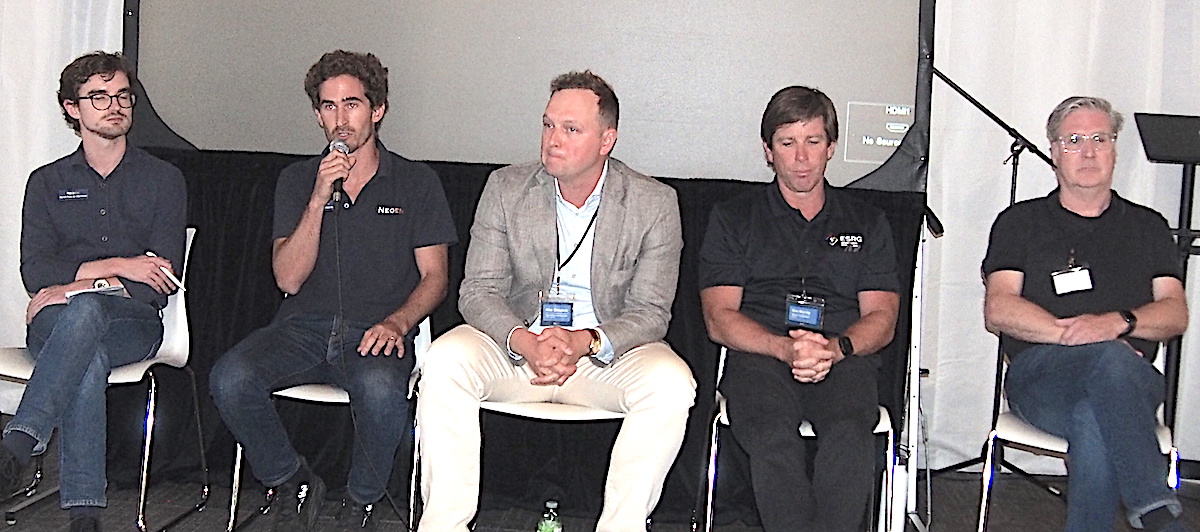
“Neoen is an independent renewable energy producer. Our long-term objective is to own and operate renewable energy projects for the life of the assets.” (Neoen website)
Janine Manning of the Chippewas of Nawash (Neyaashiinigmiing) and Joint Council of SON explained that, “This consultation process has been on-going for a couple of years and are now at the point of talking about equity and partnership. Before we would even entertain this project, they (Neoen) had to do what we asked. This development project is nothing new. Under the United Nations Declaration of the Rights of Indigenous People, we can express our stewardship throughout our traditional territory. Our participation in the development of this process comes through our treaty rights, relationship to the land and honour of the Crown in the Canadian Constitution. Our role is grounded in our traditional values and our original instructions from our Creator and relation with Mother Earth in a respectful balance and responsible way. This means assessing the impact to the land and the water. What we do today will impact our children and seven generations. Growth is sometimes necessary to grow as humans, as communities and as nations. Our responsibility is to ensure development is carried out responsibly and in alignment with our obligation to the seven generations … Neoen has respected our environmental standards including protection measures that rise above and beyond Provincial and Federal requirements … everything for SON, including an archeological assessment, has been done and approved by our SON office and recommended to our Council. Neoen has demonstrated willingness to meet SON’s high standards and to bring jobs to the community.”
According to Neoen, the project is for battery storage only and does not include wind or solar generation.
Although, according to Neoen, the project will create 200 jobs and 60 contractors, it is only through the construction phase. Once completed, there will actually be 10 jobs, with most working remotely. Also, to date, the batteries are manufactured by Tesla in California as there is no Canadian manufacturer and will also be monitored from there.
The 29-acre site is part of farmland recently purchased by Jim Caley, and surrounding neighbours have expressed several areas of concern:
- Fire Risk and Emergency Response
- Contamination Risks to Groundwater & Aquifers (Storm water)
- Species at Risk and local Wildlife
- Light Pollution
- Noise and Pollution
- Bees and Pollinators
- Infringement on future developmen rights & setback encroachments
- Minimal job opportunities
- Violation Agricultural Policy Mandates
- ‘Temporary’ project is a Myth
- Risks of Industrial Path Dependency & Use-Creep
- Lack of comprehensive Lifecycle Analysis
Only some of the questions asked are as follows:
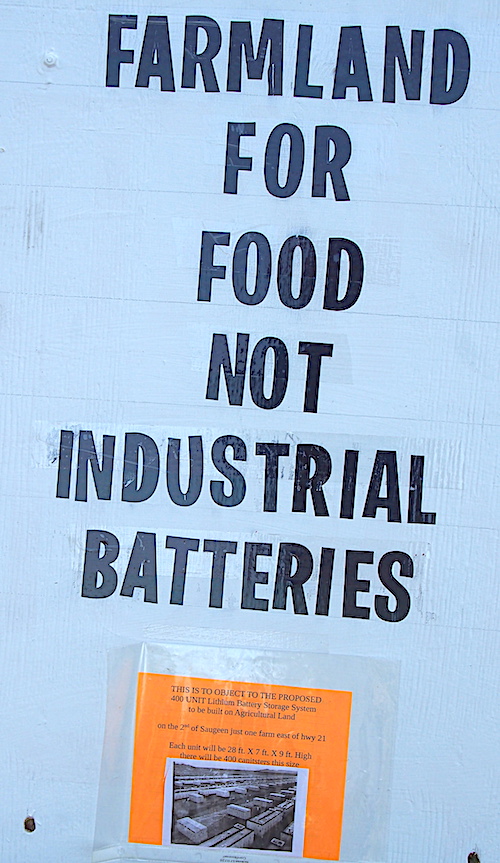
A farming neighbour, Martin Baumgartner, directly across Hwy. 21 from the proposed site said that, “I farmed that land and, in Ontario, we are losing more than 300 acres every day and it makes me sick! That’s over 116,000 acres of productive soil that is paved or developed annually and our prime agricultural land now makes up less than 5% of the province’s total land. Our Prime Minister said that food security is a matter of national sovereignty and this development will destroy prime agricultural lands now and for the future. I came from Switzerland where food security is at 46%, why can’t you find another location on marginal land? Also, what’s in it for the neighbours around this? We will have to listen to it, look at the lights all night, so what’s in it for us?”
Answer: We looked at 100 sites – cannot build close to Bruce Power, cannot build close to a buffer site and “this was a site that had the least constraints”. If construction goes ahead, we will acknowledge and respect all the concerns brought forward.
Town Councilor Dave Myette, also questioned about the aggregate that would have to be used. “On Council, we regularly receive correspondence from our neighbouring municipalities and the construction industry as there is a crisis of aggregate supply in the province right now. A number of the local quarries are now being depleted; there are new quarries being proposed which aren’t in ideal locations. If you are talking about 26 acres of land needing six to eight inches of aggregate, do you have a calculation of how much or cubic metres of aggregate will be required? This project could possibly deplete all our local resources. I would be interest in knowing the calculations of what is needed and the availability locally and regionally.”
He went to say that, the batteries being manufactured for the automative industry are currently in an over-supply, therefore, “…with an over-supply is that a reason Neoen wants to get into the battery industry?”
Answer: Neoen has started with an initial analysis. “The aggregate required has to be special to comply with electrical requirements so may be different than local aggregate. We have concerns and will look into that. We have not yet secured a source.”
The lithium-ion batteries in EVs, e-bikes and cell phones are very different and cannot be used.
Brian Smith said that, “… with Bruce Power and the wind turbines, there is enough power that will be used in Toronto rather than locally during off-peak periods so why the battery storage. Is there not enough capacity to generate 400MW of power? There is only so much power than can go down those overhead lines. Will your project jeopardize Bruce C?”
Answer: The IESO dictates and the Ministry of Energy want us here. The need is there. The system operator has said there is enough capacity on the lines even with the addition of the 400MW project.
On another topic, according to Neon, soil is removed to accommodate the development and, at the end of project life, there is a proposed decommissioning plan to rehabilitate the site. In Australia, where land was decommissioned, Neon said that the land was “only desert anyway”.
Despite the lengthy information session of more than two hours, several residents said they left without many questions being clearly answered.
Concerned citizens have a petition now in place, to sign go to – readingv@hotmai.com.